Skip to content
Chapter 2

The New Trade Map

What's being traded, who's trading it, and how it's financed are changing faster than at any point in history

Trade growth: resilient but fragile

The WTO forecasts merchandise export growth of 1.9% in 2026, down from 4.6% in 2025. But strip out AI-related goods, which accounted for almost half of all merchandise trade growth in 2025, and the picture is considerably weaker.

Services export growth continues to outpace merchandise trade by a significant and widening margin. The WTO forecasts global service exports to grow 4.8% in 2026, against merchandise growth of 1.9%.

Commercial services trade volume export growth,
baseline forecast, 2023–2027

Source: IMF, 2026a

Trade surge: AI goods, digital services and intangibles

AI-related goods now represent 15% of global trade by volume, but drove 43% of its growth in the first half of 2025. Trade in AI goods expanded 20% in H1 2025, against less than 4% for non-AI goods.

75% of the world’s semiconductor production capacity is located in Taiwan, South Korea, mainland China and Japan. The US controls IP and design. Alternative hubs are emerging - Malaysia, Singapore, Thailand and Vietnam now account for nearly 30% of global semiconductor export growth.

The rapid growth of exports in services is a structural shift in the global economy. Digitally delivered exports such as cloud computing, online finance, and remote professional services, are growing fastest of all, projected at 5.6% in 2026.

AI Goods Trade Impact

Source: WTO, 2025

AI Goods Trade Impact

The Forces Shaping the New Trade Map

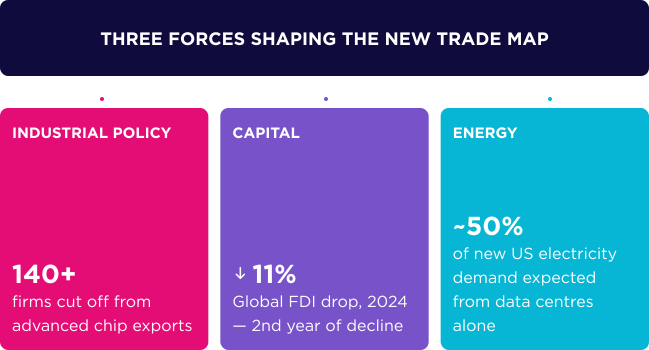
Three structural forces - industrial policy, capital and energy - have outsized influence over the transformation of trade. Understanding these forces is as important as understanding the trends they are shaping.

Global FDI fell 11% in 2024 - the second consecutive year of double-digit contraction. Interest rates and inflation remain high, exacerbated by the Iran conflict. The bright spot: technology. Investment in the digital economy doubled in value in 2024, driven by data centres, semiconductors and ICT services.

Three forces shaping the new trade map

The $2.5 trillion problem

The global trade finance gap stands at $2.5 trillion - a record set in 2024. That figure represents 10% of all merchandise. Despite stabilising, it has not closed. The gap is highly complex, structural, persistent and unequally distributed. Technology may offer solutions to finally close it.

The trade finance gap falls hardest on those who need it most. Asian Development Bank estimates that nearly half of all SME trade finance requests are rejected by banks, against a rejection rate of just 7% for multinational corporations. India and Africa face the largest shortfalls relative to trade volumes.

Global trade finance gap, 2014-2025

Source: Asian Development Bank, 2023; Asian Development Bank, 2025

DMCC Commodity Trade Index 2026

Tariffs, industrial policy and new corridors are reshaping which hubs lead. See where the world's top ten trading economies rank in 2026.

Key Recommendations

Prioritise service provisions in every negotiation

Services trade provisions, on data flows and digital market access, must carry the same weight as tariff schedules.

Accelerate legal equivalence for digital trade documents

Give digital trade documents the same legal status as paper equivalents across jurisdictions. Regulatory divergence here is one of the most direct brakes on the digitalisation of trade finance.

Deploy blended finance to close access gaps

Work with development banks to deploy blended finance instruments that reduce the risk premium on trade finance in underserved markets.

Build semiconductor supply chain risk into policy frameworks

The dominance of AI goods in merchandise trade growth exposes economies to the escalation of export controls and to the geopolitical contest over chip production capacity.

Prioritise frameworks with high-growth demographic markets

Trade and investment agreements with Asia, Africa and Latin America must reflect their growing strategic importance. Ceding first-mover advantage in these markets is a long-term cost of competitiveness.

Audit trade portfolios for services exposure

Assess what share of revenue is coming from services and digitally delivered offerings. The gap with merchandise is widening. Businesses that have not made this assessment are already operating with an incomplete picture.

Map AI supply chain risk at every tier

Identify where AI-related components sit in your supply chains and develop contingency sourcing arrangements. Export control volatility in chips is a live, evolving risk.

Benchmark your trade finance arrangements

Digital platforms now offer faster credit decisions and lower documentation burden than traditional correspondent banking. Businesses on legacy processes are accepting avoidable costs.

Factor infrastructure depth into location decisions

Energy availability, grid reliability, digital connectivity and logistics network quality are now primary considerations in trade infrastructure planning.

Download Your Future of Trade 2026 Report

DMCC Logo Future of Trade Logo

Have questions? Want to chat more?
Reach out to our experts!

Contact Us

All rights reserved. Copyright DMCC ©2026