The Technology Divide
From AI and data flows, to stablecoins and digital infrastructure, the most consequential divide in global trade is emerging between those deploying technology at scale and those that are not
AI rewiring trade but adoption is lagging
By the first half of 2025, trade across 100 AI product lines had reached $1.92 trillion. AI products and services are forecast to boost trade by nearly 40% by 2040. Yet fewer than 15% of businesses describe their AI use as fully integrated or transformational; more than 25% report observational use or no adoption.
The $581.7 billion bet
Global corporate spending on AI rose to a record $581.7 billion in 2025, up 130% from 2024. AI-driven productivity gains and reductions in trade costs could increase global flows of goods and services by 34-37% by 2040.
Accelerating AI use cases
Use cases are emerging. Toyota tracks more than 175,000 suppliers with 91% disruption accuracy, the Port of Rotterdam deploys AI to predict ship movements up to 24 hours ahead, and Alibaba has cut the average processing time for cross-border shipments into China from 72 to 18 hours.
The enabling stack: 5G, IoT and blockchain
Beyond AI, trade depends on a layer of enabling technologies that are transforming its operational infrastructure. The Port of Rotterdam has connected 15,000 IoT devices via 5G. The global IoT sensor market is forecast to reach $99.2 billion by 2030. More than 12,500 instances of blockchain deployments in supply chains were logged in 2025.
What stage best describes your organisation’s AI adoption in trade operations?
Source: DMCC Future of Trade Survey, 2026
Global data centre capacity, 2025-2030
Source: JLL. Bar chart
“What is on the table now for companies is a real desire for diversification, for lowering risk. And to do that, it means that they have to start thinking harder, what do we do, where do we do it, why do we do it?”
Head of Trade Policy, Hinrich Foundation

“Traditionally, stablecoin adoption has been the largest outside the U.S. What has changed is that institutions have realised this is an asset class large enough, and a technology that is maturing, with actual real-world use cases beyond individual investors.”
Director of Crypto Research and Strategy, Charles Schwab

The Infrastructure Behind the Intelligence
The infrastructure powering AI is as strategically contested as the technology itself. The contest for AI supremacy is, at its foundation, a contest for control of the infrastructure stack - semiconductors, data centres, power grids, cooling systems, and critical minerals.
Global semiconductor sales hit a record $697 billion in 2025. The market for graphics processing units (GPUs) is projected to reach $274 billion by 2029. Data centre demand could almost triple by 2030, requiring an estimated $6.7 trillion in investment.
The US leads global semiconductor market cap, chip design, IP and software ecosystems. China controls more than 90% of global refined rare earth output. Both have imposed export controls. Meanwhile, AI demand is driving record investment in data centre production, impacting steel production, cloud capacity, electricity grids, water resources, and more.
The shift from human to machine intelligence is changing the face of trade. The global stock of industrial robots exceeded 4.6 million in 2024. China accounts for 54% of global deployments and added 295,000 units in 2024: more than the rest of the world combined. Driverless commercial trucks hit U.S. highways in 2025, with 100,000 driverless miles since completed - with consequences for the road freight industry.
From Paper Trails to Next-Gen Payment Rails
Other technologies are reconfiguring the system that has long underpinned global trade. Stablecoins, tokens and CBDCs are providing a new generation of financial infrastructure.
Global stablecoin supply exceeded $300 billion in early 2026, up from less than $30 billion in 2020. B2B stablecoin payments grew 733% year on year in 2025. Questions are growing on their reserve currency potential.
The real-world asset tokenisation market has grown 380% in three years, reaching $24 billion in 2025. Physical commodities such as metals, energy and agricultural goods are being tokenised - HSBC's Gold Token surpassed $1 billion in traded volumes and 100,000 transactions since its launch in 2024.
Central bank digital currencies preserve central bank authority over issuance and governance. In November 2025, the UAE and China executed their first cross-border CBDC transaction using a platform built on mBridge infrastructure. As of early 2026, mBridge has processed more than 4,000 cross-border transactions valued at $55.5 billion.
Estimated stablecoin market size by 2030, base case
Source: Citi, 2025a
Where Data Cannot Flow, Trade Cannot Grow
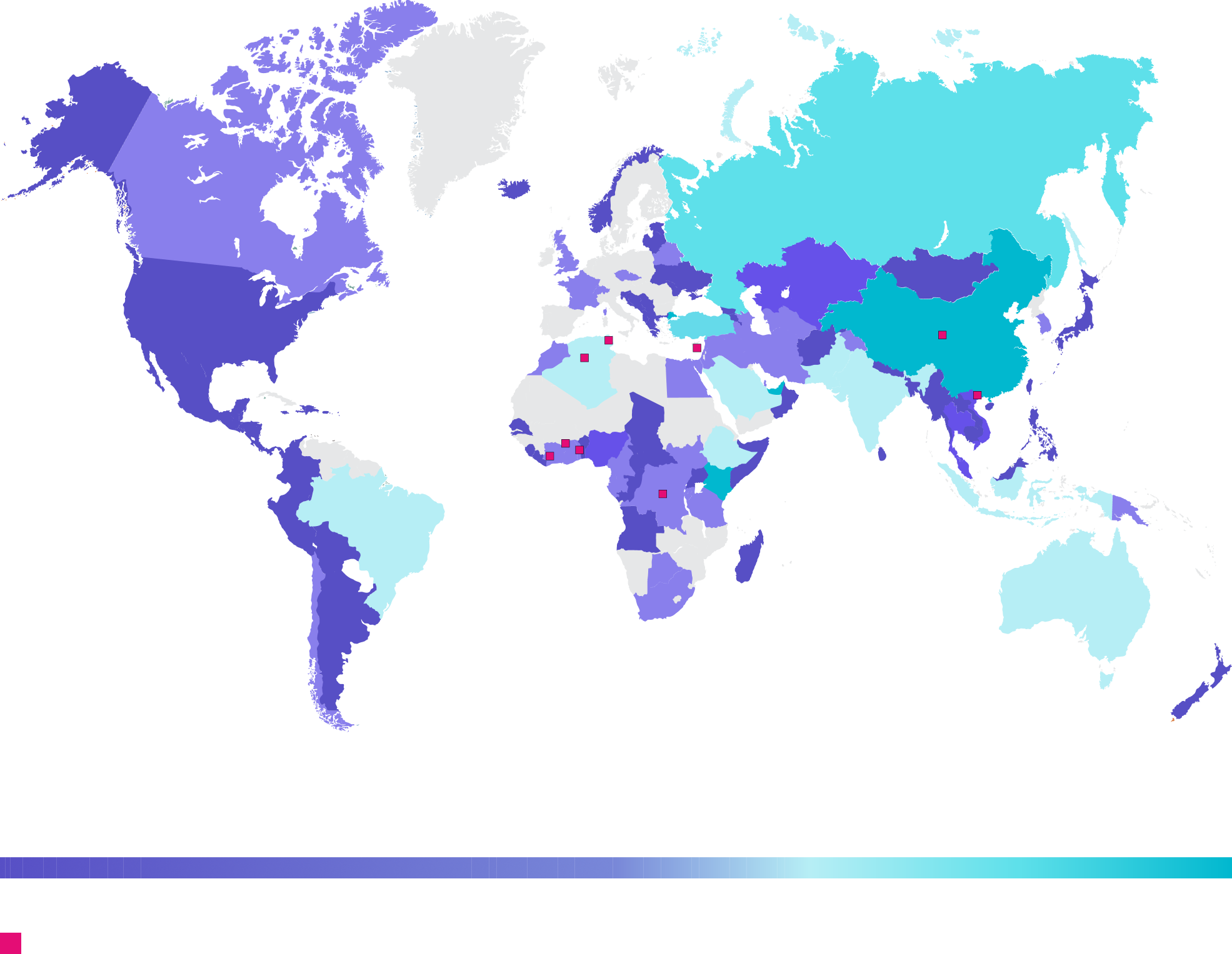
Data localisation rules and data sovereignty concerns are a major or moderate constraint on cross-border trade for more than 80% of businesses. Full data autarky could reduce global GDP by an estimated 4.5% and cut exports by 8.5%.
Restrictions on data flows act as a hamper on trade - from supply chains connecting manufacturers and logistics operators, to the training of AI models. Estimates suggest freeing up data flows could boost global GDP by 1.77% and increase global exports by 3.6%.
The expiry of the WTO's e-commerce moratorium in 2026 was the clearest signal that global digital trade rules will not be set multilaterally. Bilateral and bloc-based deals are filling the gap. The CPTPP remains the benchmark - including free data flows, restrictions on localisation, and state-to-state dispute settlement.
Number of data localisation measures by country, 2025
Source: WORLDBANK
Key Recommendations
Establish AI readiness benchmarks for trade-intensive sectors
Direct digital infrastructure investment towards the corridors and markets where the adoption gap is largest. The gap between early movers and laggards will widen significantly as agentic AI moves from pilot to production over the next three to five years.
Treat AI infrastructure as strategic national infrastructure
Treat data centres, grid capacity and semiconductor supply chains as strategic national infrastructure and plan accordingly. Factor energy availability, grid connection timelines and critical mineral dependencies into national AI strategies and planning frameworks.
Accelerate regulatory harmonisation on digital payment infrastructure
Accelerate regulatory harmonisation on stablecoin reserves, interoperability standards and CBDC corridor development. Cross-border regulatory coordination between the UAE, Singapore, Hong Kong and the UK is the logical next step.
Extend eBL legal equivalence across all major trading jurisdictions
Extend eBL legal equivalence across all major trading jurisdictions and harmonise digital signature and electronic contract frameworks. Direct development finance towards SME digitisation in underserved trade corridors.
Prioritise data flow provisions in bilateral trade negotiations
Push for mutual recognition frameworks that reduce the compliance burden on cross-border data transfers. Treat digital trade agreement negotiations as a strategic priority equivalent to tariff schedules.
Run a structured AI maturity audit across core trade operations
Map AI adoption across customs classification, demand forecasting, sanctions screening, trade finance and logistics optimisation. Identify where the gap between current deployment and best-in-class is largest and prioritise those areas for scaled investment.
Stress-test AI infrastructure dependencies
Map which AI workloads depend on single providers or jurisdictions. Distribute critical workloads across multiple providers. Factor in energy availability and grid connection timelines when deciding where to locate AI-dependent operations.
Build dual-track payment capabilities now
Maintain correspondent banking for established corridors while piloting stablecoin or tokenised settlement in markets where banking frictions are highest. Regulatory frameworks sufficient for institutional adoption now exist in the UAE, Singapore, Hong Kong and the UK.
Set internal targets for digital trade documentation
Set targets for eBL adoption, digital letters of credit and paperless customs filings across primary corridors. Provide transition support to suppliers who lack the capability to comply unilaterally.
Map data localisation exposure before expanding into new markets
Identify which jurisdictions require local storage or processing of trade-relevant data and assess whether current infrastructure can accommodate those requirements. Make modular system design a standard requirement for new development so that future localisation requirements can be met without full system rebuilds.
Engage with digital trade agreement negotiations before they conclude
Engage through industry bodies in negotiations relevant to primary trade corridors, with focus on AI governance provisions, data flow commitments and electronic trade document standards. Those that engage after ratification inherit whatever was decided without them.