Skip to content
Chapter 1

A World Trade Disorder

Rules-based multilateral trade is giving way to bilateral and bloc-based deals. Middle powers are capturing redirected investment and trade flows.

Tariffs, flashpoints and the fracturing of global trade

Sweeping Protectionism

President Trump's second term has been defined by a sustained escalation in protectionist policy. 19.7% of world merchandise imports are now affected by tariffs and similar measures, up sharply from 12.6% just a year earlier. Up to 95% of U.S. imports are impacted by tariffs under Section 301.

Merchandise imports affected by tariffs between 2025-2026

Source: WTO, 2025

The Strait of Hormuz: The World’s Energy Chokepoint

The closure of the Strait of Hormuz is one of the most disruptive events in global energy markets in recent history. Before 2026, ~25% of global seaborne oil and 19% of global LNG transited the strait daily. By mid-April 2026, tanker transits were running approximately 90% below pre-war levels.

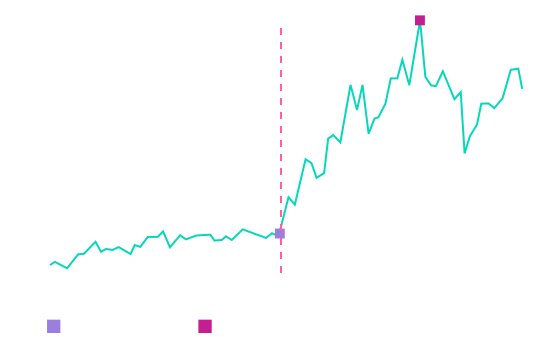
The energy shock has been immediate and severe. Brent crude surged above $120 per barrel, double the $60 level at the start of 2026.

Brent crude oil prices have spiked since March 2026
Source: EIA, 2026
Brent crude oil prices have spiked since March 2026

U.S. imports from alternative partners to China have escalated: up 72% from Mexico, 94% from India, and 345% from Vietnam

Source: UN Comtrade, 2026

From “China + 1” to “China + many”

Global supply chain strategies have shifted from "China + 1" to "China + many". U.S. imports from China contracted 5% overall between 2014 and 2024.

Case Study: Apple and the Limits of “China + Many”

Apple's supply chain restructuring is the most closely watched experiment in the "China + many" model. Its track record illustrates both the opportunity and the limits of that strategy.

Diversifying Beyond China

India accounts for approximately 18% of global iPhone production, with a target of around 25% in the coming years. In 2025, Apple committed approximately $1.5 billion to a new Foxconn component plant in India, shifting from simple assembly towards deeper supply chain integration. 

Apple final assembly volume by geography

Source: Bain & Company; sources from Apple company reports and filings

The Limits of the Model

Political pressure on the "China + many" model is growing. Donald Trump has urged Apple to prioritise U.S.-based production, and the company has since pledged $500 billion in domestic investment. The pressure to reshore, even if the wider economics may not support it, illustrates a tension that every multinational operating a diversified supply chain could face.

Projected outcomes

India as a scaled production hub

India's share of iPhone production is projected to reach 25%, establishing it as a genuine alternative to China for high-volume consumer electronics manufacturing.

Supply chain extension, not decoupling

Chinese suppliers are internationalising alongside Apple, meaning the "China + many" model deepens interdependence rather than severing it.

Political durability under pressure

The model will face sustained political pressure to reshore to the US. Businesses that can demonstrate credible domestic investment while maintaining diversified international operations will be best positioned.

From Rules to Relationships

Trade Gravity Shifts

The IMF forecasts that by 2030, emerging and developing economies will account for around two-thirds of global GDP growth. Trade and investment are increasingly driven by regional groupings, middle powers and developing economy blocs.

Per cent of global imports occurring between partners in regional trade compacts surged

Source: WTO, 2025a

Per cent of global imports occurring between partners in regional trade compacts surged

Key Recommendations

Map tariff exposure dynamically across every major trade corridor

Governments should maintain live scenario models that identify at what tariff threshold specific sectors or trade routes become commercially unviable, and have pre-agreed response protocols ready.

Invest in middle power partnerships

The UAE, India, Singapore and Vietnam are capturing redirected trade and investment flows through deliberate positioning. Policymakers should prioritise trade and investment frameworks with these middle powers.

Rebuild multilateral dispute settlement

The WTO's dispute settlement mechanism is defunct. Governments should invest in regional and bilateral arbitration frameworks to fill the vacuum.

Secure freedom of navigation

The Iran conflict has demonstrated the vulnerability of global trade to chokepoint disruption. Governments should coordinate multilateral responses to protect critical sea lanes and develop contingency frameworks for supply route disruption. 

Maintain live tariff scenario models

Businesses should maintain dynamic models that identify at what tariff threshold specific products, suppliers or routes become commercially unviable, and have pre-agreed response protocols ready to activate.

Treat "China + many" as a continuous discipline

Diversification commitments are present across most sectors; the operational infrastructure is still being built. Businesses that treat this as a one-time exercise will be caught out by the next disruption.

Develop an explicit position on middle power hubs

The UAE, India, Singapore and Vietnam are becoming the connective hubs of the new trade architecture. Businesses should assess their market presence, partnerships and regulatory relationships in these markets.

Build contingency plans for chokepoint disruption

The Iran conflict has demonstrated that energy, food and digital infrastructure all depend on the same physical chokepoints. Supply chain resilience planning must account for prolonged disruption to key sea lanes.

Download Your Future of Trade 2026 Report

DMCC Logo Future of Trade Logo

Have questions? Want to chat more?
Reach out to our experts!

Contact Us

All rights reserved. Copyright DMCC ©2026