Clean Energy: The Race for Industrial Supremacy
The global energy transition has evolved into a contest for industrial supremacy. Security is the primary driver causing a multiplier effect across critical minerals, grids, and clean tech supply chains
Betting on the Transition
Investment in the low-carbon energy transition hit a record $2.3 trillion globally in 2025, up 8% from 2024. For the first time, investment in the electricity sector is running roughly 50% higher than capital deployed across the hydrocarbons supply. The old energy order is not fading, but it is being outspent.
Energy transition investment by region
Asia Pacific accounts for almost half of global energy transition capital, driven by manufacturing dominance, EV deployment and supply chain control. China invested $800 billion in 2025 alone. The EU grew 18% to $455 billion. U.S. investment rose 3.5% to $378 billion.
Four strategies, four outcomes
By the end of 2025, companies in the US had cancelled or downsized 61 clean energy projects representing $34.8 billion in abandoned investment. It was the first year on record in which more clean energy investment left the US than arrived. China invested $800 billion in 2025 alone.
The geography of clean energy
Global energy transition investment, 2005-2025
Source: BloombergNEF, 2026b
Global energy transition investment, 2005-2025
Source: BloombergNEF, 2026b
“There already is a boom in energy demand due to AI generation... Now that there's an energy security crisis, everyone's going to be trying to look for alternative energies... And China is the leader in solar and wind technology.”
Head of Policy and Geopolitical Risk, Kpler

“There’s always been a shift towards more and more renewable energy, but that’s been very much driven by a climate change agenda. Now the move towards renewable energy is driven closer and closer to energy security.”
Chief Growth Officer, Hitachi EMEA

Four Strategies, One Race
Four regions are building structural positions around the energy transition - or conceding ground.
China
China is leading, turning the transition into a manufacturing advantage. It now controls over 70% of global manufacturing capacity across major clean tech segments.

United States
The US is retreating. 2025 was the first year in which more clean energy investment left the US than arrived. Renewable investment fell 36% in the first half of 2025, with capital largely moving to Europe.

Europe
Europe is hesitating. It has the policy ambition but faces an estimated €477 billion annual funding gap and its manufacturing costs are significantly higher than China's.

The Gulf
The Gulf is hedging, actively using hydrocarbon revenues to finance clean technologies. GCC countries have invested over $37.7 billion in around 62.9 GW of renewable energy projects as of October 2025.
Who Controls the Inputs, Controls the Transition
Critical minerals are the foundation of the clean energy economy. Lithium, cobalt, copper, nickel, rare earths, and graphite are the inputs in EVs, batteries, wind turbines, and solar panels, grid transformers and the semiconductor supply chains that underpin AI. Without access to the inputs, the energy transition stalls.
Demand for critical minerals from clean technologies alone is projected to rise two to four times by 2040 as electricity networks, EVs and battery storage expand. Lithium demand could go up 51 times. Cobalt and graphite 30 times. But the average lead time from discovery to production is 16 years. Supply cannot meet demand.
The real chokepoint is not mining but refining. China leads refining for 19 of 20 strategic minerals tracked by the IEA, with an average refining share above 90% for graphite, manganese and rare earths. It is using its leverage - restricting exports on a swathe of minerals. The US has responded with Project Vault, a $12 billion stockpiling initiative. Battle lines between major powers are being drawn.
Total mineral demand for clean energy technologies, 2010-2040
Source: IEA, 2021b
EVs driving clean tech investment
Electric vehicles offer a useful case study of the wider clean tech contest. The global EV fleet reached almost 58 million by end-2024, with a record 21 million EVs added in 2025. Around 250 million are expected by 2030. China dominates this arena too. Seven out of ten EVs sold globally are Chinese, while the country is responsible for 80% of global battery cell production. The EU and US have responded with tariffs. Middle powers are positioning themselves as alternative manufacturing locations.
Electricity demand from EVs could reach four times today's level by 2030, in addition to surging demand from AI data centres. Forecasts expect an extra 50% more annual electricity demand in the next five years than the entire past decade. Yet the gap between what the transition requires and what the grid can currently deliver is already visible in the data: 1,700 GW of renewable energy projects across European countries were stuck in grid connection queues in 2025.
Production, demand and net trade of EVs in major global markets
Source: IEA, 2025b
From climate to security: The reframing of the transition
The energy transition is no longer primarily driven by climate ideology – it is driven by energy security and industrial strategy. The consequences are increased protection and fragmentation: domestic manufacturing mandates, export controls, bilateral deals, and a suspicion of dependencies on suppliers from different blocs.
In our Future of Trade survey, 42% of businesses had not modelled the impact of carbon pricing on their operations at all, and carbon border measures ranked last in the order of sustainability factors expeted to shape global trade. The pressure businesses feel is directed at control of critical minerals, manufacturing capacity and grid infrastructure.
Trade in environmentally sound technologies
Different regions are driving the acquisition and diffusion of environmentally sound technologies (ESTs) around the world with manufacturing capabilities, domestic policies and emissions targets all key influencing factors.
Largest EST exporters
China has committed to rapid electrification of its energy systems, paving the way for renewables, particularly solar. Germany has also introduced household incentives in order to meet its 2045 net zero emissions target.
| Rank | Country | Value (Billions USD) |
|---|---|---|
| 1 | China | 183.3 |
| 2 | Germany | 101.5 |
| 3 | United States | 81.7 |
| 4 | Italy | 44.5 |
| 5 | Japan | 33.7 |
| 6 | Mexico | 27.1 |
| 7 | Republic of Korea | 25.3 |
| 8 | France | 23.1 |
| 9 | Netherlands | 22.9 |
| 10 | United Kingdom | 21.6 |
Largest EST importers
The US remains by far the largest importer of ESTs. Its imports were greater than those of China and Germany combined.
| Rank | Country | Value (Billions USD) |
|---|---|---|
| 1 | United States | 135.7 |
| 2 | China | 63.5 |
| 3 | Germany | 54.7 |
| 4 | Mexico | 30.8 |
| 5 | United Kingdom | 27.6 |
| 6 | France | 26.2 |
| 7 | Canada | 24.0 |
| 8 | Republic of Korea | 20.9 |
| 9 | Netherlands | 19.9 |
| 10 | Japan | 19.9 |
The language of carbon targets has been overtaken by the language of energy security. The Iran conflict and oil supply shocks have accelerated that reframing - and the transition itself
Source: BloombergNEF, 2025b
The future of trade in environmentally sound technologies
Trade in ESTs faces challenges caused by sweeping tariffs, the US downgrading renewables, and disruptions to shipping lanes caused by the Strait of Hormuz closure. Despite these headwinds, the medium to long term looks more promising, as countries and companies move to self-sufficiency and insulation from supply shocks.
In the most likely scenario, commodity price volatility drives diversification. Developed economies shift to higher-value, less resource-intensive trade profiles. China continues to capture EST market share.
Multilateral frameworks, from WTO-structured discussions to bilateral agreements such as the ACCTS, deliver coherent expansion of free trade in environmental goods.
Sweeping tariffs and inflationary pressures from the Iran conflict strengthen the case against net zero targets. Competitive pressure creates incentives for others to follow, compounding the deceleration.
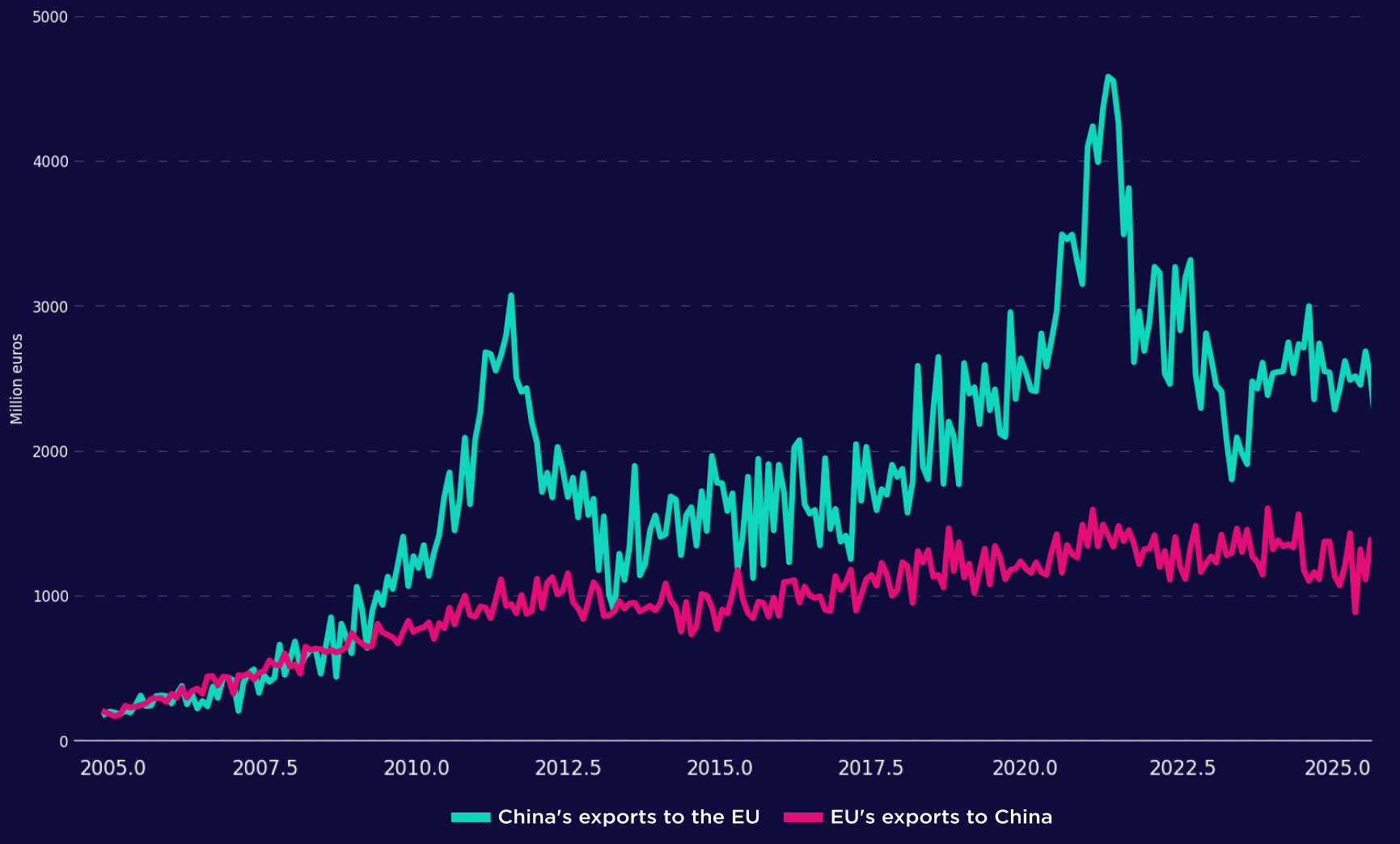
EU/China trade in environmentally sound technologies
Source: Eurostat, Cebr analysis
Key Recommendations
Map clean-tech supply chain dependencies across all tiers
Prioritise bilateral processing capacity agreements over mining agreements. Provide clear investment frameworks for third-party refining infrastructure that can attract private capital at scale.
Publish clear, binding grid connection timelines
Create fast-track approval mechanisms for strategic clean tech manufacturing investments. Factor energy availability, grid connection timelines and critical mineral dependencies into national clean energy strategies.
Provide clear forward guidance on CBAM expansion timelines
Allow businesses to plan supply chain transitions with adequate lead time. Regulatory predictability is itself a competitive advantage in attracting clean tech manufacturing investment.
Engage Gulf sovereign wealth funds as strategic co-investors in clean tech infrastructure
Gulf sovereign wealth funds are deploying patient capital across clean-tech supply chains on terms and timescales that private markets are structurally unable to replicate. Map where Gulf capital is flowing and explore bilateral cooperation frameworks accordingly.
Map clean-tech supply chain dependencies across all tiers
Identify where single-country exposure exists at the refining stage, not just mining.
Determine which product lines require dual-bloc sourcing
Model the cost and operational implications of parallel sourcing and make an explicit decision rather than deferring it.
Factor grid reliability, connection timelines and power cost into location decisions before committing capital
Require grid capacity assessments as a standard component of site evaluations for any clean-tech manufacturing investment.
Integrate CBAM exposure into procurement and commercial planning
Model CBAM exposure across the supplier base and engage suppliers on decarbonisation pathways where the commercial case supports it.
Assess Gulf sovereign capital flows and identify co-investment opportunities across clean tech supply chains
Explore co-investment or partnership structures where commercial alignment exists in logistics, commodity processing, or clean-tech infrastructure.