.svg "Special cocoa Edition")
the future of trade
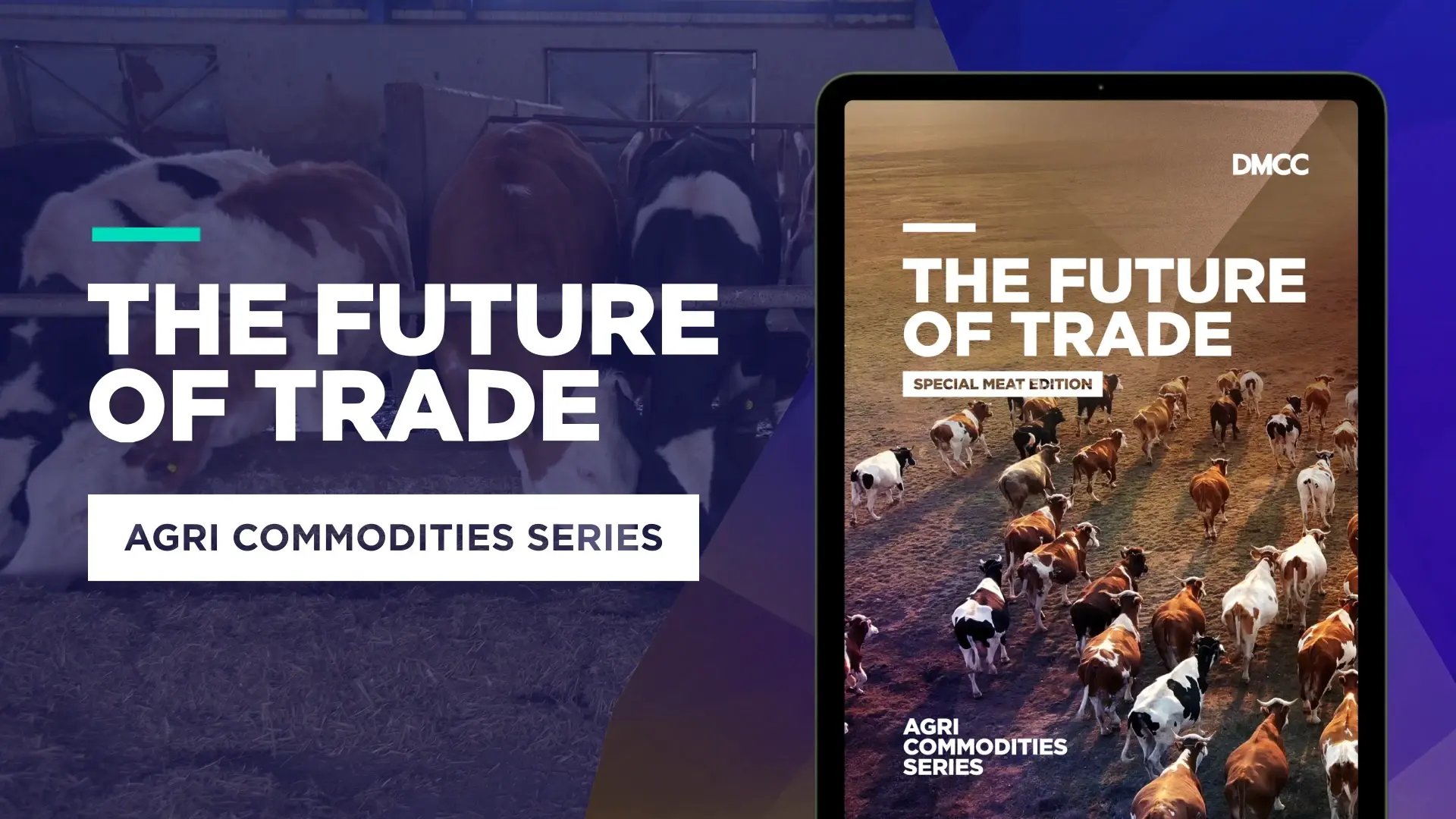
DMCC FUTURE OF TRADE AGRI SERIES - MEAT EDITION
In the final edition of our five-part Agri Commodity series, we examine the global meat industry at a moment of structural change. As consumption accelerates across emerging markets, trade is being reshaped by rising sustainability and welfare standards, supply-chain shocks, and tightening biosecurity risks. This report explores how digital traceability, intelligent processing, and next-generation cold-chain infrastructure are redefining competitiveness - and how global hubs like Dubai are positioned to anchor the new, standards-driven geography of meat trade.
Reports in the Five-Part Agri Commodities Series:


THE FUTURE OF MEAT
The meat industry faces pressure from modest production growth and a shifting regulatory landscape in which environmental and sanitary standards are effectively becoming new tariffs.
In the Future of Trade: Meat report, explore how the industry is adapting through integrated value chains, digital traceability, and resilience strategies to navigate supply chain disruptions.
THE GLOBAL MEAT TRADE
THE MEAT INDUSTRY TODAY
TRADE CHALLENGES AND OPPORTUNITIES
KEY PLAYERS AND VALUE CHAIN DYNAMICS
DUBAI IN THE GLOBAL MEAT TRADE
THE FUTURE OF MEAT
01
GLOBAL MEAT LANDSCAPE
Download report
Meat trade flows are pivoting toward markets in Asia and the Middle East, driven by urbanisation and rising incomes. At the same time, buyer expectations are shifting from volume toward value, traceability, and stricter environmental standards.
Global consumption patterns are diverging. As meat demand in advanced economies plateaus, nearly all incremental growth by 2034 is expected to come from upper-middle-income countries. To hedge against supply constraints and meet this demand, the industry is accelerating investment in alternative proteins, with the plant-based market forecast to nearly quadruple to $25 billion by 2030.
02
MEAT TRADE CHALLENGES AND OPPORTUNITIES
Download report
The global meat trade is shifting from tariff-based negotiations to complex regulatory frameworks. Sustainability and sanitary standards are emerging as the new gatekeepers, with new regulatory frameworks requiring unprecedented levels of traceability.
Beyond regulation, the industry faces biological and geopolitical risks. Recurring outbreaks of avian flu and African swine fever, combined with geopolitical challenges and logistical disruptions, are forcing a strategic pivot from pure efficiency toward defensive diversification and proactive biosecurity.
03
THE KEY PLAYERS IN THE MEAT TRADE
Download report
The industry is defined by significant market concentration, with vertically integrated giants utilising economies of scale to dominate global exports.
Counterbalancing this concentration is a push for transparency. Retailers and regulators are increasingly mandating strict compliance, driving the adoption of blockchain and satellite monitoring to verify origin and ensure supply chains meet emerging deforestation-free standards.
04
DUBAI’S ROLE IN THE FUTURE OF MEAT TRADE
Download report
Dubai has emerged as both a major demand centre and the GCC’s most connected distribution hub, underpinned by world-class logistics, advanced cold-chain infrastructure and a robust halal compliance framework. Even as domestic capacity expands, the UAE’s role as a regional import gateway continues to grow, with chicken meat imports alone forecast to reach 410,000 tonnes by 2026.
DMCC strengthens this ecosystem by hosting over 26,000 companies and providing access to a ready-made compliance and distribution stack, including the Halal National Mark and accredited laboratories, which streamline upstream sourcing, traceability and price discovery. Together, these assets position Dubai as a pivotal node in the evolving global meat supply chain.
05
INNOVATIONS AND INVESTMENTS IN THE MEAT TRADE
Download report
The meat industry is set to enter a new phase of industrialisation defined by intelligence and precision. Blockchain technology has shifted from an optional add-on to a competitive necessity, serving as the backbone for end-to-end supply chain transparency and regulatory trust.
Additionally, the Southeast Asian cold-chain market is projected to reach over $15 billion by 2030, while producers are increasingly adopting genomic tools to breed livestock capable of withstanding extreme climate volatility.
CASE STUDY: CONNECTING THE GLOBAL MEAT TRADE THROUGH DUBAI
Dubai’s significance as a global trading post rests on three key advantages: connectivity, compliance and scale. Meanwhile, forward-thinking policy initiatives make it the perfect location for firms to expand globally.
Policy Initiatives
A strong focus on policy frameworks has helped Dubai secure its position as a rising meat trade nexus. The UAE’s Halal National Mark provides an assurance framework that smooths the flows of halal products into and out of the country. Meanwhile, Dubai’s Zadi single-window integrates food import, re-export and label assessment with customs and port services, helping to compress clearance times for traders.
DMCC’s Meat Ecosystem
Anchored by a “platform plus infrastructure” model, DMCC supports over 26,000 companies with specialised ecosystems for tea, coffee, and agro-commodities. DMCC’s Tradeflow enables traders to unlock working capital by collateralising inventory. Several DMCC-licensed firms are already trading frozen meat and poultry from Dubai, capitalising on both DMCC’s Commodity Ecosystem and Jebel Ali’s advanced cold-chain infrastructure.
THE FUTURE OF MEAT
Key Recommendations
- Strengthening supply chain resilience
Geopolitical tensions and recurrent disease outbreaks have exposed the industry to unprecedented external shocks. To stabilise trade flows in this volatile era, resilience must hinge on flexibility. Strengthening biosecurity protocols and diversifying transport routes away from traditional corridors are now essential strategies for survival. - Accelerate technical adoption
Technology adoption has become a core determinant of competitiveness, essential for enhancing efficiency and building climate resilience. The industry must mainstream digital grading, automated processing, and global digital infrastructure to ensure traceability, reduce fraud, and maintain compliance with evolving carbon and animal welfare standards. - The cold-chain of the future
Expanding and greening cold-chain capacity is vital to securing protein flows amid climate volatility. Investment must prioritise energy-efficient refrigeration, solar-powered warehouses, and intelligent temperature analytics to cut spoilage and emissions. - Integrate emerging producers into international supply networks
Rising protein demand in Asia, Africa and the Middle East is reshaping trade corridors. To link emerging producers to global value chains, policymakers must foster regional processing hubs and harmonised frameworks, while supporting digital platforms such as DMCC’s Agriota to connect smallholders with exporters and build resilience. - Rewire finance around data
Future trade finance must evolve from physical collateral to data-backed assurance. Institutions should reward traceability and low-carbon performance with preferential credit. The shift from paper to digital documentation must also become the industry norm. - Future-proofing through innovation partnerships
The meat sector must prepare for convergence with the broader protein economy, spanning cultivated and hybrid products. Trade hubs can future-proof operations by investing in innovation zones that integrate logistics, R&D and digital services, allowing exporters to pivot as global preferences shift toward sustainable sources.